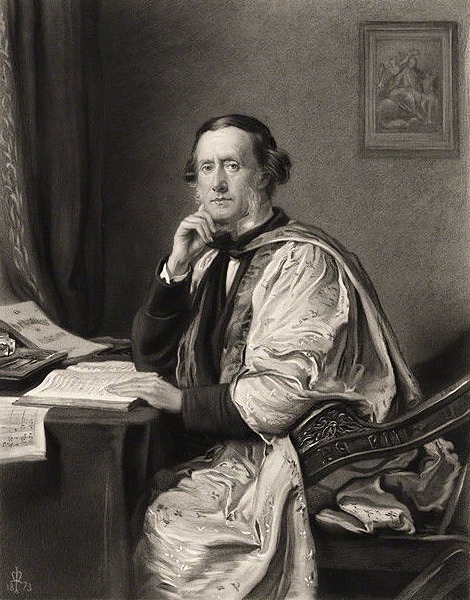

William Sterndale Bennett
1816 — 1875
Sir William Sterndale Bennett was an English composer, pianist, conductor and music educator. At the age of ten Bennett was admitted to the London Royal Academy of Music (RAM), where he remained for ten years. By the age of twenty, he had begun to make a reputation as a concert pianist, and his compositions received high praise. Among those impressed by Bennett was the German composer Felix Mendelssohn, who invited him to Leipzig. There Bennett became friendly with Robert Schumann, who shared Mendelssohn’s admiration for his compositions. Bennett spent three winters composing and performing in Leipzig.
Adapted from the Wikipedia article on William Sterndale Bennett.
From the period sources
William Sterndale Bennett, a distinguished English composer, was educated from a young age by his grandfather, John B., a lay-clerk at Cambridge, after his organist father died when Bennett was three (A Biographical Dictionary of Musicians, 1900). He entered the Royal Academy of Music at age ten, studying with Ch. Lucas, Dr. Crotch, C. Potter, and W. H. Holmes. His talent was recognized early; in 1833, he performed an original piano concerto in D minor at an Academy prize concert, a work later published by the institution.
Bennett’s career was significantly shaped by his time in Leipzig, where the Broadwood firm sponsored his studies in 1837, with a return visit in 1841-42. There, he formed close friendships with Schumann and Mendelssohn, whose influence, particularly Mendelssohn’s, is evident in some of his compositions (A Biographical Dictionary of Musicians, 1900). Indeed, Schumann dedicated his Études Symphoniques to Bennett in 1837, adopting a theme for the finale as a compliment to the English composer, who had just arrived in Leipzig (Cyclopedia of Music and Musicians, 1888). Bennett was considered “the most gifted English composer since Purcell” by Famous Composers and Their Works (1891), which also noted his charming overtures, “The Naiads” and “The Wood Nymph,” as having a place among classical orchestral music. His overture Die Najaden was notably performed under Mendelssohn’s direction in Leipzig in 1837 (Cyclopedia of Music and Musicians, 1890). Despite his talent, Biographical Dictionary of Musicians (1886) suggested that “had he been more careful in his worldly relations, [he] might have proved one of the greatest among recent musicians,” though it acknowledged his music as “more than commonplace” and many pieces as showing “genius of a decidedly original turn.”