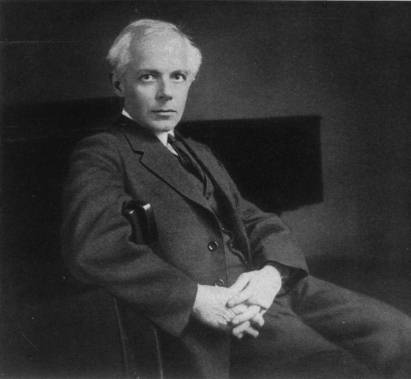

Béla Bartók
1881 — 1945
Béla Viktor János Bartók was a Hungarian composer, pianist and ethnomusicologist. He is considered one of the most important composers of the 20th century; he and Franz Liszt are regarded as Hungary’s greatest composers. Among his notable works are the opera Bluebeard’s Castle, the ballet The Miraculous Mandarin, Music for Strings, Percussion and Celesta, the Concerto for Orchestra and six string quartets. Through his collection and analytical study of folk music, he was one of the founders of comparative musicology, which later became known as ethnomusicology. Per Anthony Tommasini, Bartók “has empowered generations of subsequent composers to incorporate folk music and classical traditions from whatever culture into their works,” and was “a formidable modernist who in the face of Schoenberg’s breathtaking formulations showed another way, forging a language that was an amalgam of tonality, unorthodox scales and atonal wanderings.” His work is often described as being a combination of traditional peasants’ folk music and avant-garde music.
Adapted from the Wikipedia article on Béla Bartók.
From the period sources
Béla Bartók, a Hungarian pianist and composer, was a pupil of Kersch and L. Erkel, and later studied at the Pest Music Academy, where he became a professor in 1906, according to The New Encyclopedia of Music and Musicians (1924). He was recognized among the leading Hungarian song writers of his day, alongside figures like Emll Abranyi and Erno Lanyi, as noted in Grove’s Dictionary of Music and Musicians (1922). Bartók dedicated significant time to exploring, collecting, arranging, and publishing both old and modern folk-music from his country, a pursuit greatly aided by the Kisfaludy Society. Indeed, Grove’s Dictionary (1922) acknowledges its own debt to “M. Béla Bartók for information, and for examples from his MS. collection of folksongs,” highlighting his expertise in the field. His early works include the symphonic poem Kossuth, orchestral suites, and a piano-quintet, while later compositions mentioned are the opera Ritter Blaubarts Burg (1918), the pantomime Der wunderbare Prinz (1919), and the dance-play Der holzgeschnitzte Prinz (1922). He also edited a collection of Hungarian, Slovak, and Rumanian folk-songs, and collaborated with Zoltan Kodaly on collections of Hungarian folk-songs and laments.