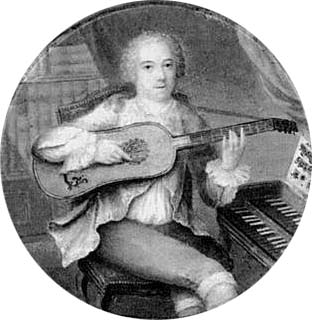

Claude-Bénigne Balbastre
1724 — 1799
Claude Balbastre was a French composer, organist, harpsichordist and fortepianist. He was one of the most famous musicians of his time.
Adapted from the Wikipedia article on Claude Balbastre.
From the period sources
Claude-Bénigne Balbastre, a Parisian organist, was a pupil of Jacques Février, who himself served as organist at Abbeville and is depicted in Choquet’s “tableau des hommes illustres d’Abbeville,” according to Fétis’s Biographie universelle des musiciens (1880). Balbastre’s harpsichord, a Ruckers instrument, was visited by Burney during his famous tour. Burney described it as “painted inside and out with as much delicacy as the finest coach or snuff-box he had ever seen,” with the cover depicting the story of Rameau’s ‘Castor and Pollux,’ and Rameau himself “depicted crowned with a wreath,” as Grove’s Dictionary (1908, 1922) records. Burney found its tone “delicate rather than powerful” and its touch “very light.” This instrument, more than a century old when Burney saw it, also bore an inscription of Balbastre’s own “Pastorale” dated August 6, 1767. Later, according to Rimbault’s The Pianoforte (1860), it became the property of Mr. Goding of London, who sacrificed the Ruckers’ work to display its Boucher and Le Prince paintings on a new grand piano.
Balbastre was also a pupil of the distinguished theoretician J. P. Rameau, and is noted in A History of Pianoforte-Playing and Pianoforte-Literature (1897) as a figure under whom the “former serious clavier style degenerated into complete shallowness.” His published compositions, including “Pieces de clavecin” and “Quatre suites de Noels,” are described in the same source as “full of incorrect and trashy phrases.” Despite this critical assessment of his compositions, his organ-playing, particularly his Christmas pieces or “Noels,” drew such large crowds to St. Roch and later to the cathedral of Paris, where he was organist, that the Archbishop was compelled to prohibit his performances at midnight masses between 1762 and 1766.