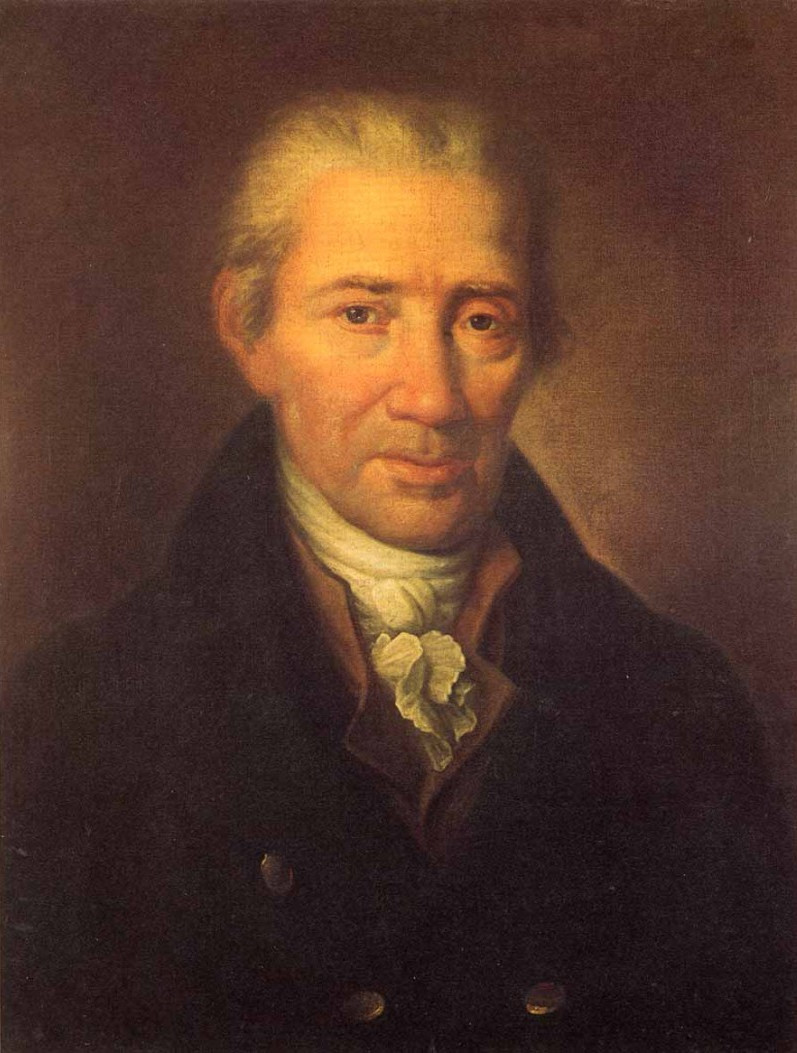

Johann Georg Albrechtsberger
1736 — 1809
Johann Georg Albrechtsberger was an Austrian composer, organist, and music theorist, widely regarded as one of the leading figures in counterpoint and composition theory during the Classical period. He was a prolific composer of church music, orchestral works, and keyboard pieces, though he is best remembered for his influence as a teacher.
Adapted from the Wikipedia article on Johann Georg Albrechtsberger.
From the period sources
Johann Georg Albrechtsberger, a distinguished theorist, composer, and teacher, held significant positions in Vienna, serving as court organist from 1772 to 1792, and then as Kapellmeister at St. Stephen’s from 1792 (Biographical Dictionary of Musicians, 1886; Dictionary of Music, 1896). His profound contrapuntal learning is reflected in his published works, and his theoretical treatises, such as “Gründliche Anweisung zur Komposition” (1790) and “Kurzgefässte Methode den Generalbass zu erlernen” (1792), were highly regarded for their lucidity and detailed exposition (Dictionary of Music, 1896). These works were influential enough to be translated into French by A. Choron in 1814 and 1815, and later into English as “Science of Music” by Joseph Francis Duggan in 1842 (Biographie universelle des musiciens, 1837; A Biographical Dictionary of Musicians, 1900).
Albrechtsberger was a sought-after instructor, counting among his pupils such notable figures as Hummel, Weigl, Eybler, Mosel, Preindl, Seyfried, and famously, Beethoven (Biographical Dictionary of Musicians, 1886). His lessons in counterpoint with Beethoven in 1794 led to a memorable, if unprophetic, assessment: Albrechtsberger declared that Beethoven “has learned nothing, and will never do anything properly” (A Biographical Dictionary of Musicians, 1900). Despite this judgment, Beethoven’s contrapuntal exercises under Albrechtsberger were later published, revealing “the irrepressible conflict between B.’s imagination and the dry course of study prescribed” (A Biographical Dictionary of Musicians, 1900). Other pupils included Joseph Preindl, who succeeded Albrechtsberger as Kapellmeister of St. Stephen’s in 1809, and Friedrich Stein, who studied counterpoint and composition with him at the age of ten (Biographie universelle des musiciens, 1837; Grove’s Dictionary, 1922). Even Muzio Clementi intended for his talented pupil Jean Field to study counterpoint with Albrechtsberger in Vienna (Biographie universelle des musiciens, 1837).